Why Artificial Intelligence for IT Operations (AIOps) is a Must for Modern Enterprises

Futurism Technologies
February 11, 2026 - 1.2K 5 Min Read
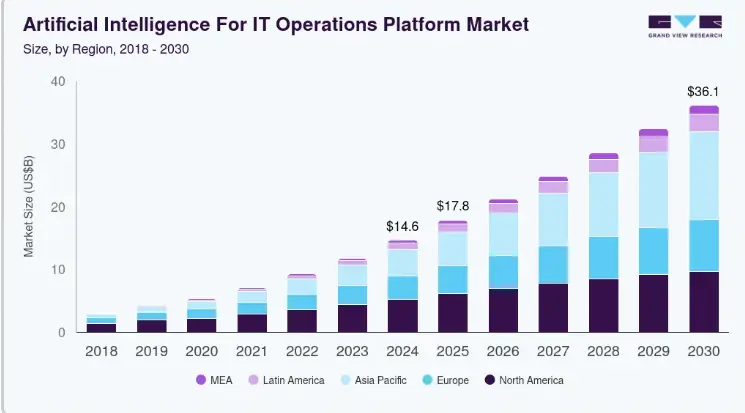
Did you know the global market for artificial intelligence for IT operations (AIOps) is projected to reach USD 11.16 billion in 2025, up from USD 8.91 billion in 2024?
For enterprise IT and operations leaders, that’s a clear signal moving from manual, reactive operations to intelligent, proactive systems isn’t just an option it’s a must. In today’s hybrid‑cloud, multi‑cloud and distributed IT environments, the volume of logs, metrics, tickets and events is simply too great for traditional human driven processes to manage. Enter AI for IT operations, or “AIOps”.
In this article, we’ll explore exactly what AIOps is, why it matters for organizations like yours (especially in manufacturing, retail, BFSI and large scale enterprises) and how to get started so you can lead the transformation rather than lag behind.
What Is AIOps?
At its core, AIOps (again, shorthand for artificial intelligence for IT operations) is the application of machine learning, big data analytics and automation technologies to IT and operations data enabling better visibility, smarter incident management and self‑remediation capabilities.
In practical terms, this means:
- Collecting massive amounts of telemetry from systems (logs, metrics, events, tickets, network flows)
- Using statistical & ML techniques (anomaly detection, pattern recognition, root‑cause analysis) to spot issues or predict disruptions before they occur.
- Automating responses (or guiding human operators) to reduce mean time to detect (MTTD) and mean time to repair (MTTR)
- Providing unified visibility across often fragmented systems (on‑premise, cloud, microservices, containers) and bridging silos (ITOps, DevOps, SecOps)
Think of it as moving from “someone finally notices an alert and then hunts for the cause” to “the system flags a pattern, surfaces the cause, suggests (or takes) remedial action before the business suffers.”
Why It Matters – The Business Case for Enterprises
For leaders in enterprise IT especially in industries such as manufacturing, retail, financial services (BFSI), telecom and global digital services the case for artificial intelligence for IT operations (AIOps) is clear and growing.
1. Managing Complexity at Scale
Modern IT environments are complex hybrid clouds, microservices, containers, IoT, edge deployments. That complexity brings volume, velocity and variety of data. Traditional tools and manual methods struggle.
In short: if you’re operating at scale, you need smarter tooling.
2. Cost, Risk and Downtime Reduction
According to recent research, enterprises that adopt AIOps see materially lower operational costs, fewer outages and improved service availability.
Imagine reducing unplanned downtime in your manufacturing line or avoiding performance bottlenecks in your retail digital platform during peak traffic. That’s the kind of outcome AIOps enables.
3. Faster Time to Value and Better Business Alignment
With AIOps you move from reactive firefighting to proactive operations. That means your IT operations become business enablers ensuring uptime, agility, and cost efficiency.
From a market perspective: one forecast estimates the AIOps market will grow at a CAGR of ~22.4% between 2025–2034 and reach USD 44.1 billion by 2034.
If your competitors adopt AIOps and you don’t, you risk falling behind.
4. Bringing IT and Business Closer
In organizations where IT operations are a black box, visibility and accountability suffer. AIOps creates dashboards, alerts and insights that link IT performance to business KPIs (customer experience, revenue, SLA compliance). For example, root‑cause analysis might surface that a cloud cost spike is tied to a microservices change something traditional monitoring misses.
5. Enabling Future‑Ready Operations
Finally, adopting AIOps sets you up for the next frontier: autonomy, self‑healing systems and intelligence at the edge. What started as “we need better monitoring” becomes “we need operations that learn, adapt and heal”. In 2025 many enterprises say AIOps is no longer optional it’s essential.
How to Get Started with AIOps
The concept is powerful but successful implementation requires disciplined strategy. Here’s a roadmap tailored for enterprise decision‑makers.
Step 1: Define the Business Outcome and Scope
First ask: What are the biggest pain‑points in your operations? Examples:
- Unplanned downtime in manufacturing equipment
- Retail application performance issues during sales events
- Cloud cost overruns in BFSI environment
- Alert fatigue or tool‑sprawl in your global IT operations team
Define a measurable goal (e.g., “Reduce MTTR by 30% in the next 12 months”, “Cut infrastructure cost by 15% via intelligent optimization”). Tie the AIOps initiative to business KPIs so it gets priority investment.
Step 2: Inventory and Consolidate Data Sources
AIOps thrives on data. But many enterprises still have fragmented tooling: log managers, ticket systems, performance monitors, cloud cost tools, IoT sensors. Aggregation is key.
- Identify the data sources. (logs, metrics, events, network flows, change‑records)
- Ensure you can ingest, normalize and correlate these data streams.
- Prioritize high‑value use‑cases first. (e.g., anomaly detection on infrastructure, root cause analysis for application performance)
Read Also – Data Integration Unlocked: From Silos to Strategy for Competitive Success
Step 3: Select the Right Platform and Tools
There are many AIOps companies and platforms the fit depends on your environment (cloud/hybrid), data volume, skill‑set and maturity. Look for platforms that support:
- Anomaly detection and pattern recognition
- Event correlation and root‑cause analytics
- Automatic or semi‑automatic remediation/orchestration
- Hybrid cloud and multi‑cloud support
- Built‑in dashboards aligned with business KPIs
Step 4: Build the Use‑Case, Pilot and Expand
Don’t try to boil the ocean. Start with one high‑impact, manageable use‑case: e.g., anomaly detection in your manufacturing IoT network, or cloud cost optimization in your retail stack.
- Pilot the solution: ingest data, train models, refine alerts
- Measure: establish baseline metrics (current MTTR, cost, downtime)
- Monitor, iterate, and expand scope to other processes
Step 5: Bring People, Process and Governance into Play
Technology alone doesn’t solve the problem. To succeed:
- Have a cross‑functional team (IT operations, DevOps, business leadership)
- Define new workflows: how will alerts from AIOps be handled? Who owns the remediation?
- Manage change: training, governance, deciding which actions will be automated vs manual
- Establish KPIs and governance: e.g., alert reduction, incident resolution time, cost savings
Step 6: Scale, Expand and Embed Continuous Improvement
Once the pilot proves value:
- Scale to additional systems (edge, IoT, multi‑cloud)
- Introduce more advanced capabilities: predictive analytics, self‑healing operations, autonomous remediation
- Link results to business outcomes: show how IT operations improvements translated to customer experience, revenue growth, regulatory compliance
- Continuously optimize: Data models drift, infrastructure changes so keep refining
Key Use Cases by Industry
Manufacturing / Smart Factory
Applying AIOps in a smart‑factory environment: correlate IoT sensor data, machine logs, network latency and application performance to detect equipment degradation before failure. The result? Reduced downtime, improved output and optimized maintenance scheduling.
Read Also – Smart Factory: The Present of Manufacturing Innovation
Retail / eCommerce
For retail chains, digital experience is everything. AIOps monitors application performance, transaction success, cloud cost, network latency and infrastructure dependencies. It can automatically detect problems (for example, checkout slowdown during peak hours) and alert or remediate before customers abandon the cart.
BFSI (Banking, Financial Services and Insurance)
In BFSI, compliance, uptime and customer trust are non‑negotiable. AIOps helps monitor complex hybrid‑cloud banking systems, correlate security alerts with application performance, and deliver unified visibility into the entire infrastructure reducing risk, boosting resilience and improving customer experience.
Multi‑Cloud / Cloud‑Native Environments
Modern enterprises increasingly operate across multiple clouds, edge, SaaS, PaaS. AIOps becomes the “single pane of glass” for managing this complexity combining logs, traces and metrics across clouds and providing intelligent insights. For example, research predicts that by 2024, 80 % of AIOps companies will integrate generative AI to improve usability and adoption.
Why Partner with Futurism Technologies for Your AIOps Journey
At Futurism Technologies, we specialize in end‑to‑end digital transformation from consulting to implementation, to operations. If you’re looking to adopt AI for IT operations, we bring:
- Deep domain expertise across manufacturing, retail, BFSI, telecom and global enterprises
- Branded solution sets and frameworks designed for rapid value delivery
- Experience in hybrid and multi‑cloud environments, IoT and smart factory use‑cases A proven approach to align IT operations upgrades with business goals
We don’t just deliver tools we help you shape your data foundation, set up pilots, roll out enterprise scale AIOps platforms and embed automation into your culture.
Conclusion
The era of reactive IT operations is over. With the rise of artificial intelligence for IT operations (AIOps), enterprise IT organizations have the chance to move from firefighting to foresight. With market projections showing double digit growth and clear return‑on‑investment potential, the question isn’t if you should adopt AIOps it’s how fast you will make the transition.
If you lead IT/operations at a manufacturing, retail, BFSI or large scale enterprise and you’re ready to accelerate operations, cut costs, improve uptime and create a business aligned operations engine let’s talk.
Schedule a consultation with our AIOps experts. Your transformation starts now don’t let your competition get ahead.
AI in Procurement Is Entering Its Agentic Era: What CXOs…
Applications of Agentic AI: How This Emerging Technology is Shaping…

AI Personalization ROI: The $500M Opportunity for Enterprises

37M Copilot Conversations’ Shocking Truth & Why Futurism Agentic AI…
Why Artificial Intelligence for IT Operations (AIOps) is a Must…

AI Inventory Management: How AI Helps U.S. Retailers Reclaim Billions…
Subscribe Now!
TRENDING POSTS
-
AI Personalization ROI: The $500M Opportunity for Enterprises
-
Zero-Click Marketing: Why Enterprises Must Rethink Attribution in the Digital Age
-
Agentic AI and Generative AI: What’s Best for Your Business?
-
Deepfake Scams: How to Protect Your Business in the Age of AI
-
AI and Cybersecurity: A Strategic Guide for C-Suite Leaders in 2025
-
How Location Intelligence is Revolutionizing BFSI: 6 Must-Know Benefits
-
Cloud and Data Engineering: The Path to Faster Insights and Smarter Decisions
-
From Delays to Innovation: How AI is Optimizing the Construction Industry
-
Data-Driven Future: 6 Trends to Watch Out For
-
The Impact of IoT on Reducing Maritime Carbon Footprints
-
Demystifying SASE: What is Secure Access Service Edge?
-
The Role of AI in Construction Safety
-
What Is Predictive Maintenance and Why Does It Matter?
-
What is Ransomware-as-a-Service (RaaS)? Everything You Need To Know
-
The Role of Smart Maritime IoT Solutions in Enhancing Maritime Safety
-
Revolutionizing Telecom with AI-Driven Network Slicing
-
Data Integration Unlocked: From Silos to Strategy for Competitive Success
-
Navigating the Shadows: Understanding Zero-Click Attacks in the Digital Age
-
AI Reimagined: Crafting Next-Gen AI Apps with Expert Fine-Tuning
-
Futurism AI: Turning Ideas into Apps at Lightning-Fast Speed
-
Accelerate AI Across Your Enterprise With Futurism AI
-
Flying into the Future: How AI is Redefining the Future of Aviation
-
Beyond Intelligence: The Rise of Self-Healing AI
-
The Indispensable Role of a Trusted Offshore AI Company in 2024 & Beyond
-
IoT-Powered Smart Warehouse Management: A Detailed Guide
-
Turning Data into Dollars: The Futurism Path to AI-Driven Success
-
5 Ways to Prepare Your Business for Digital Transformation
-
4 Ways To Win at Digital Transformation on a Shoestring Budget
-
Why AI in Digital Marketing is the Next Big Thing?
-
How AI Will Enable Faster Adaptation of Digital Transformation
-
How Is Digital Modernization Important In Supplier On-Boarding?
-
Top 10 Email Marketing Tips for This Holiday Season
-
Benefits of using ERP Software for Energy and Gas Industries
-
5 Features of Supply Chain Management Software
