AI Personalization in Digital Marketing: How to Turn Customer Signals into Revenue

Futurism Technologies
November 4, 2026 - 2.2K 5 Min Read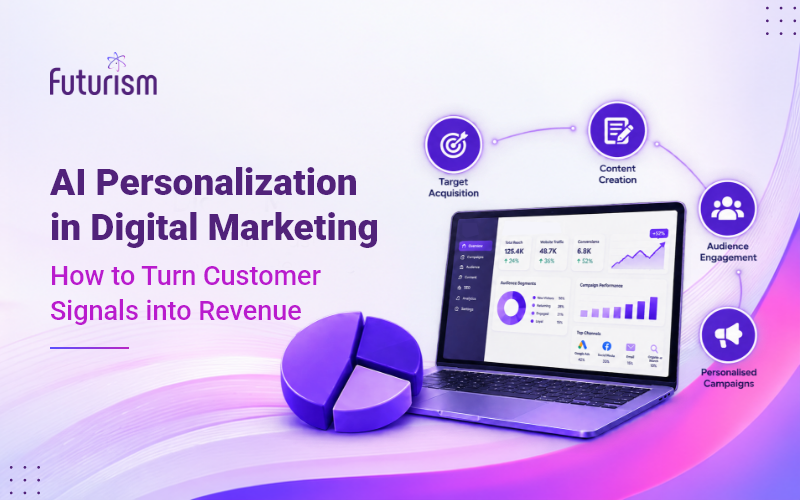
Your team can see which pages prospects revisit, which emails earn responses, and where customers abandon purchases. Yet high-intent leads still receive generic follow-ups, retention risks surface late, and budget flows to audiences unlikely to convert. The gap is not data. It is knowing which signal should change the next action.
AI personalization connects those signals to decisions that can increase conversions, strengthen retention, and grow customer lifetime value. The goal is not to customize every interaction. It is to make the next interaction useful enough to move a buyer or customer forward.
What Is AI-Powered Personalization?
For decision-makers, AI powered personalization means adapting content, offers, recommendations, and outreach to a prospect’s buying stage or a customer’s likely next need. Its value depends on whether those changes improve a business outcome, not how many variations a platform can generate.
Why Traditional Personalization Is No Longer Enough
Fixed segments and manual rules fall behind when prospects change priorities, revisit pricing, or compare vendors. AI for personalization helps teams respond to new signals without creating rules for every scenario. Better-timed follow-ups can turn interest into pipeline or allow retention teams to address problems before customers leave.
How AI Is Used for Marketing Personalization
Personalized Website Experiences
Visitors often leave when a page does not answer their next question. Adapt proof points, content, and calls to action to the buying stage. New visitors can explore educational resources, while active evaluators can find case studies or demo options. Better next steps help qualified prospects convert.
AI Content Personalization
The right resource depends on the decision a prospect needs to make. AI content personalization can guide early-stage readers to problem-solving content and active evaluators to comparison or implementation resources. Linking each asset to the next buying question helps content contribute to pipeline, not just downloads, as part of a broader digital marketing strategy.
Personalized Email Marketing
An open or click means little if the follow-up goes nowhere. AI personalization marketing can adjust message timing and content to engagement and buying stage, helping teams avoid sending introductory material to someone ready to speak with sales. The aim is fewer low-value touches and more progress toward a decision.
Personalized Advertising
Broad reach can consume budget without generating qualified demand. AI can refine audience selection, creative, and delivery around stronger buying signals, shifting spend toward people more likely to convert. This makes campaign efficiency easier to judge by lead quality and revenue rather than clicks alone.
Product Recommendations
The first purchase is only one revenue opportunity. Recommendations based on purchase history and product exploration can surface useful add-ons or likely next purchases, supporting cross-sell, upsell, and repeat orders. For eCommerce teams, this can increase customer lifetime value without relying entirely on discounts.
Personalized Customer Journeys
Prospects rarely move through a neat, linear funnel. Someone comparing vendors needs different follow-up from someone who has booked a demo. AI personalization can adapt nurture sequences to those milestones, while better marketing automation workflows reduce repeated messages and improve marketing-to-sales handoffs.
AI Chatbots and Conversational Marketing
When prospects cannot get clear answers quickly, they may leave or delay contacting sales. AI powered customer engagement can answer common questions and guide visitors to relevant resources or the right team. This reduces friction while helping sales focus on more promising conversations.
These applications work best when teams know which audiences and accounts deserve attention first. Segmentation makes that prioritization more deliberate.
AI Customer Segmentation
AI customer segmentation helps teams group audiences according to what matters for their next marketing or sales decision.
- Behavioral segmentation: Use page visits, purchases, and campaign engagement to tailor follow-up and identify the next useful action.
- Demographic segmentation: Apply industry, location, company size, or customer profile to improve targeting and message fit.
- Intent-based segmentation: Prioritize prospects showing signs of active evaluation so sales can engage while the opportunity is live.
- Predictive segmentation: Anticipate likely next actions to guide campaign timing and allocate resources more carefully.
- High-value customer identification: Find accounts with stronger revenue, expansion, or lifetime value potential and focus growth or retention efforts accordingly.
Together, these approaches make AI personalization marketing more actionable. Rather than treating every lead equally, teams can prioritize opportunities where timely action is more likely to influence revenue.
Predictive Analytics in Digital Marketing
Predictive analytics in marketing helps teams act before an opportunity is lost or a customer leaves. Predictive analytics can turn customer and campaign data into decisions that protect revenue, guide investment, and create time for intervention.
- Purchase prediction: Identify likely buyers and time offers or outreach more effectively.
- Churn prediction: Flag customers at risk while there is still time to address the issue.
- Lead conversion prediction: Prioritize prospects with stronger conversion potential.
- Customer lifetime value prediction: Direct acquisition, retention, and expansion investment toward higher long-term value.
- Campaign performance prediction: Estimate likely results to inform budget allocation before spend is committed.
- Product recommendations: Anticipate relevant next purchases and create cross-sell or repeat-revenue opportunities.
The relationship between predictive analytics and marketing is not about forecasting for its own sake. Hyper personalization AI creates value when predictions prompt timely outreach, useful recommendations, or retention action that changes the outcome.
Benefits of AI-Powered Personalization
The payoff should be visible in commercial performance, not just opens and clicks. Better-fit messages and next steps can improve conversions, while useful recommendations support repeat revenue and customer lifetime value. Earlier churn signals give teams a chance to retain customers before they leave.
There is also an efficiency gain. Teams can focus spend on audiences with stronger potential and reduce repetitive manual rules. Done well, personalized digital marketing can improve marketing ROI while creating a more consistent customer experience across channels. The business case is strongest when each use case has a defined metric and baseline for comparison.
How to Implement AI Personalization
Start with one measurable outcome, then expand only when results justify further investment. A focused plan helps decision-makers assess technology choices without letting the platform define the strategy.
- Set the goal: Choose a priority such as qualified conversions, churn reduction, repeat purchases, or acquisition cost.
- Select one use case: Focus on an interaction where better timing or targeting can change the result.
- Check data readiness: Connect reliable website, CRM, purchase, and campaign data needed for that use case.
- Measure impact: Compare conversion, retention, customer lifetime value, or marketing ROI against a baseline.
- Scale on evidence: Expand successful use cases when the gains justify investment and the experience works for customers.
This approach gives teams a practical way to evaluate AI for personalization and demonstrate value before expanding across more channels.
Make AI Personalization Work for the Business
The advantage is not personalizing every interaction. It is knowing which signals can change a decision, acting in time, and measuring whether that action affected revenue or retention. AI personalization marketing becomes a growth capability when it helps teams make better commercial decisions, not simply add more technology.
At Futurism Technologies, we connect customer data, AI insights, and marketing execution across AI-driven digital marketing, predictive analytics, AI customer segmentation, content personalization, and marketing automation. The focus is practical: improve conversion opportunities, retain valuable customers, and make marketing investment more effective.
Choose the customer journey where better timing could make the biggest measurable difference. Book your free consultation today.
FAQs
How does AI personalization improve marketing ROI?
It helps teams refine targeting and timing while reducing ineffective outreach. Measure conversions, retention, and revenue to determine whether the investment is paying off.
How can small and mid-sized businesses use AI personalization marketing?
Start with email follow-ups, website content, or product recommendations. Expand when results justify investment instead of rolling out personalization everywhere at once.
What role do predictive analytics and marketing play in retention?
Predictive analytics can flag churn risks early, giving teams time to resolve issues, improve follow-up, and protect recurring revenue.
What does personalisation in digital marketing require?
It requires reliable data, a clear objective, and outcome measurement. Website activity, purchase history, email engagement, and CRM records are practical starting points.
What are the biggest challenges of AI personalization?
Fragmented data, unclear goals, poor data quality, and disconnected execution can limit results. A focused use case and measurement plan help manage these risks.
How to Build an AI-Powered Digital Marketing Strategy That Drives…
Zero-Click Marketing: Why Enterprises Must Rethink Attribution in the Digital…
How to Ace Your Digital Marketing Campaigns with AI

Essentials of an ‘AI-Native’ Digital Marketing Service Provider

Digital Marketing: The Catalyst for Startup Success in 2024 &…

AI and the Future of Marketing: Turning Data into Digital…
Subscribe Now!
TRENDING POSTS
-
AI Personalization ROI: The $500M Opportunity for Enterprises
-
Zero-Click Marketing: Why Enterprises Must Rethink Attribution in the Digital Age
-
Agentic AI and Generative AI: What’s Best for Your Business?
-
Deepfake Scams: How to Protect Your Business in the Age of AI
-
AI and Cybersecurity: A Strategic Guide for C-Suite Leaders in 2025
-
How Location Intelligence is Revolutionizing BFSI: 6 Must-Know Benefits
-
Cloud and Data Engineering: The Path to Faster Insights and Smarter Decisions
-
From Delays to Innovation: How AI is Optimizing the Construction Industry
-
Data-Driven Future: 6 Trends to Watch Out For
-
The Impact of IoT on Reducing Maritime Carbon Footprints
-
Demystifying SASE: What is Secure Access Service Edge?
-
The Role of AI in Construction Safety
-
What Is Predictive Maintenance and Why Does It Matter?
-
What is Ransomware-as-a-Service (RaaS)? Everything You Need To Know
-
The Role of Smart Maritime IoT Solutions in Enhancing Maritime Safety
-
Revolutionizing Telecom with AI-Driven Network Slicing
-
Data Integration Unlocked: From Silos to Strategy for Competitive Success
-
Navigating the Shadows: Understanding Zero-Click Attacks in the Digital Age
-
AI Reimagined: Crafting Next-Gen AI Apps with Expert Fine-Tuning
-
Futurism AI: Turning Ideas into Apps at Lightning-Fast Speed
-
Accelerate AI Across Your Enterprise With Futurism AI
-
Flying into the Future: How AI is Redefining the Future of Aviation
-
Beyond Intelligence: The Rise of Self-Healing AI
-
The Indispensable Role of a Trusted Offshore AI Company in 2024 & Beyond
-
IoT-Powered Smart Warehouse Management: A Detailed Guide
-
Turning Data into Dollars: The Futurism Path to AI-Driven Success
-
5 Ways to Prepare Your Business for Digital Transformation
-
4 Ways To Win at Digital Transformation on a Shoestring Budget
-
Why AI in Digital Marketing is the Next Big Thing?
-
How AI Will Enable Faster Adaptation of Digital Transformation
-
How Is Digital Modernization Important In Supplier On-Boarding?
-
Top 10 Email Marketing Tips for This Holiday Season
-
Benefits of using ERP Software for Energy and Gas Industries
-
5 Features of Supply Chain Management Software
