Digital Assembly Lines: What If AI Stops Giving Answers and Starts Running Operations

Futurism Technologies
September 18, 2026 - 3.2K 5 Min Read
Most enterprises have already proven that Generative AI can generate content. Teams use AI to write emails, summarize reports, draft code, analyze documents, and answer questions faster than ever before. The experimentation phase is largely over.
The challenge now is far more strategic. Can AI execute work, not just generate outputs?
For enterprises, speed-to-value no longer comes from helping employees write better prompts. It comes from eliminating the operational bottlenecks that slow decision-making, approvals, and execution across the business.
This is where the conversation shifts from generative AI to agentic AI and from isolated use cases to what many industry leaders are beginning to call digital assembly lines.
The GenAI Plateau: Why Prompts Alone Don’t Scale
The first wave of enterprise AI focused on productivity. An employee asks a question. AI produces an answer. The employee reviews it, copies the output, moves it into another system, and continues the process.
The result is faster task completion, but the workflow itself remains largely unchanged. In many organizations, AI has accelerated individual activities without removing the underlying process friction:
- Teams still move information between systems manually.
- Approvals still depend on human intervention.
- Data remains fragmented across applications.
- Critical decisions continue to wait for handoffs between departments.
While Generative AI reduces the effort required for individual tasks, it rarely eliminates the operational steps that slow execution.
As a result, many enterprises find themselves stuck between successful AI pilots and meaningful business transformation.
What Is a Digital Assembly Line?
A digital assembly line is an interconnected system of AI agents, business applications, data sources, and governance controls that continuously execute multi-step business processes with minimal human intervention.
Instead of generating a single output and stopping, the system coordinates multiple actions across the enterprise. Think of how a physical manufacturing assembly line works.
Each station performs a specific task before passing the work to the next stage. Together, those stations create a finished product efficiently and consistently.
Digital assembly lines operate the same way, except the “workers” are specialized AI agents collaborating across enterprise systems. Rather than asking AI for answers, organizations assign AI a business objective. The system then determines how to accomplish it.
Generative AI vs. Agentic AI: Understanding the Key Differences
The distinction is not about intelligence. It is about execution. Generative AI produces output. Agentic AI produces outcomes.
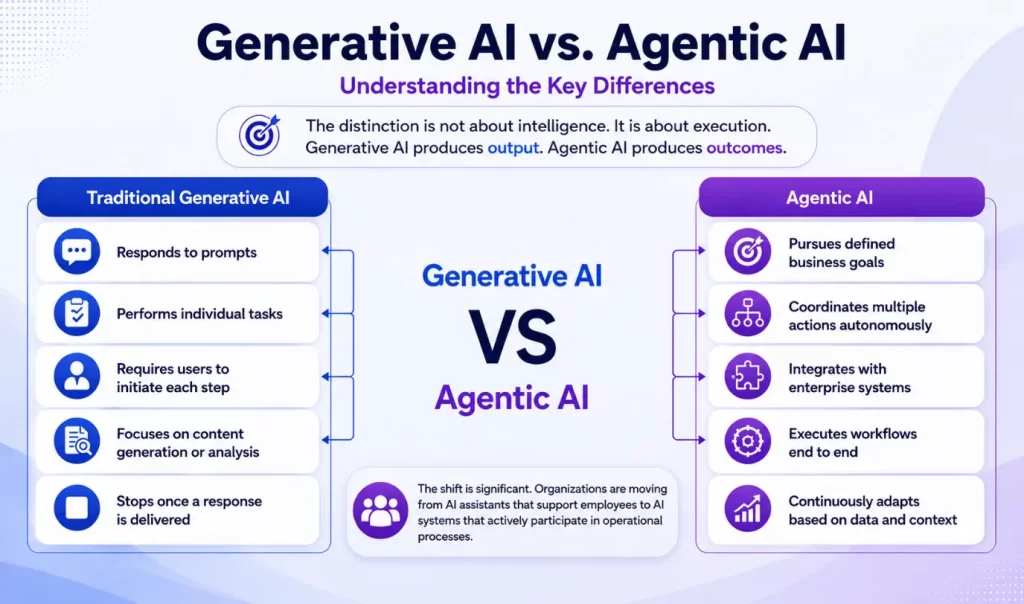
The shift is significant. Organizations are moving from AI assistants that support employees to AI systems that actively participate in operational processes.
Also Read: Agentic AI and Generative AI: What’s Best for Your Business?
How Agentic AI Powers Digital Assembly Lines
Consider a common enterprise scenario: a supply chain disruption. In a traditional environment, multiple teams become involved.
Operations identifies the issue. Procurement evaluates alternatives. Finance reviews costs. Customer support prepares communications. Leadership monitors risk.
Every handoff creates delays. An agentic workflow operates differently.
When a disruption occurs:
- Monitoring Agents detect anomalies from supplier feeds, ERP systems, or logistics platforms.
- Analysis Agents assess inventory levels, historical performance, contractual obligations, and potential business impact.
- Decision Agents evaluate alternative suppliers, transportation options, and mitigation strategies.
- Execution Agents update ERP records, trigger procurement workflows, generate stakeholder notifications, and escalate exceptions when required.
- Human Oversight Layers review high-risk decisions before final execution.
Instead of waiting for information to move between teams, the digital assembly line orchestrates the process automatically while keeping leadership informed and in control. The result is not simply faster information. It is faster execution.
The Real Challenge Isn’t AI. It’s Workflow Design.
Many organizations assume success depends on choosing the right large language model. In reality, the bigger challenge lies elsewhere.
The most successful agentic AI initiatives are not defined by the sophistication of the model. They are defined by the quality of the workflow architecture around it. This includes:
- Business process mapping
- System integrations
- Data accessibility
- Governance controls
- Human approval mechanisms
- Security and compliance frameworks
Organizations often discover that AI itself is not the bottleneck. The bottleneck is the fragmented infrastructure that prevents systems from working together.
An AI agent cannot automate procurement decisions if supplier data is trapped in one system, contracts are stored in another, and financial information exists somewhere else entirely. Without connectivity, autonomy cannot scale.
Why Governance Matters More Than Automation
One of the biggest misconceptions surrounding agentic AI is that autonomy means removing humans from the process. Enterprise leaders know better.
The most effective agentic systems are designed around Human-in-the-Loop governance. Not every decision should be automated.
High-value transactions, compliance-sensitive activities, and strategic decisions often require executive oversight. This means successful digital assembly lines include:
- Role-based permissions
- Approval workflows
- Audit trails
- Transparency into agent reasoning
- Risk thresholds and escalation policies
The goal is not unrestricted automation. The goal is controlled autonomy. Organizations that balance execution speed with governance will unlock the greatest long-term value from AI.
Where Enterprises Should Start
Many leaders assume they need a company-wide AI transformation initiative before adopting agentic AI. They do not.
The most effective approach is to begin with a single high-impact workflow. Look for processes that:
- Involve multiple handoffs
- Depend on several disconnected systems
- Generate operational delays
- Require repetitive decision-making
- Have measurable business outcomes
Examples include:
- Customer onboarding
- Claims processing
- Procurement approvals
- Service desk operations
- Order management
- Supply chain coordination
Start with one workflow. Measure outcomes. Refine the architecture. Then expand the model across the organization. Digital assembly lines are built incrementally, not all at once.
A Real-World Example: 800+ AI Agents Across Manufacturing and Supply Chain
This is no longer just a theoretical model. Google Cloud reported in 2026 that GE Appliances had deployed more than 800 AI agents across manufacturing, logistics, and supply chain.
The significance isn’t simply the number of agents. It is where they are being deployed.
Manufacturing, logistics, and supply chain are environments where work rarely happens inside one application or one department. A decision may depend on operational data, engineering information, logistics conditions, inventory, production schedules, and other systems.
That makes these environments a natural fit for agentic architectures. The broader pattern Google Cloud identified is a move toward AI agents that can connect and coordinate complex business processes rather than operating as isolated assistants.
And that is precisely what makes the assembly-line analogy useful. One AI assistant can accelerate a task. A connected network of AI agents can transform a workflow.
Why Enterprises Need Architects, Not Just AI Vendors
The future of enterprise AI will not be determined by who has access to the best model. Leading models are increasingly becoming available to everyone.
Competitive advantage will come from how effectively organizations connect AI, data, systems, and workflows into a unified operational engine.
That requires more than software. It requires architecture.
At Futurism Technologies, we help organizations design and deploy digital assembly lines that transform disconnected processes into autonomous, outcome-driven workflows. By combining AI engineering, enterprise integration expertise, and governance-first implementation strategies, we enable businesses to move from AI experimentation to measurable operational impact.
The next era of enterprise AI is no longer about generating better responses. It is about building systems that execute work. And the organizations that master digital assembly lines today will define the operational benchmarks of tomorrow.
Ready to turn AI experiments into autonomous business outcomes?
Is AI Recommending Your Brand in Search Results?
AI in Procurement Is Entering Its Agentic Era: What CXOs…
Applications of Agentic AI: How This Emerging Technology is Shaping…

AI Personalization ROI: The $500M Opportunity for Enterprises

37M Copilot Conversations’ Shocking Truth & Why Futurism Agentic AI…
Why Artificial Intelligence for IT Operations (AIOps) is a Must…
Subscribe Now!
TRENDING POSTS
-
AI Personalization ROI: The $500M Opportunity for Enterprises
-
Zero-Click Marketing: Why Enterprises Must Rethink Attribution in the Digital Age
-
Agentic AI and Generative AI: What’s Best for Your Business?
-
Deepfake Scams: How to Protect Your Business in the Age of AI
-
AI and Cybersecurity: A Strategic Guide for C-Suite Leaders in 2025
-
How Location Intelligence is Revolutionizing BFSI: 6 Must-Know Benefits
-
Cloud and Data Engineering: The Path to Faster Insights and Smarter Decisions
-
From Delays to Innovation: How AI is Optimizing the Construction Industry
-
Data-Driven Future: 6 Trends to Watch Out For
-
The Impact of IoT on Reducing Maritime Carbon Footprints
-
Demystifying SASE: What is Secure Access Service Edge?
-
The Role of AI in Construction Safety
-
What Is Predictive Maintenance and Why Does It Matter?
-
What is Ransomware-as-a-Service (RaaS)? Everything You Need To Know
-
The Role of Smart Maritime IoT Solutions in Enhancing Maritime Safety
-
Revolutionizing Telecom with AI-Driven Network Slicing
-
Data Integration Unlocked: From Silos to Strategy for Competitive Success
-
Navigating the Shadows: Understanding Zero-Click Attacks in the Digital Age
-
AI Reimagined: Crafting Next-Gen AI Apps with Expert Fine-Tuning
-
Futurism AI: Turning Ideas into Apps at Lightning-Fast Speed
-
Accelerate AI Across Your Enterprise With Futurism AI
-
Flying into the Future: How AI is Redefining the Future of Aviation
-
Beyond Intelligence: The Rise of Self-Healing AI
-
The Indispensable Role of a Trusted Offshore AI Company in 2024 & Beyond
-
IoT-Powered Smart Warehouse Management: A Detailed Guide
-
Turning Data into Dollars: The Futurism Path to AI-Driven Success
-
5 Ways to Prepare Your Business for Digital Transformation
-
4 Ways To Win at Digital Transformation on a Shoestring Budget
-
Why AI in Digital Marketing is the Next Big Thing?
-
How AI Will Enable Faster Adaptation of Digital Transformation
-
How Is Digital Modernization Important In Supplier On-Boarding?
-
Top 10 Email Marketing Tips for This Holiday Season
-
Benefits of using ERP Software for Energy and Gas Industries
-
5 Features of Supply Chain Management Software
