Digital Transformation in Healthcare: Connected Systems, Smarter Care

Futurism Technologies
November 23, 2026 - 6.2K 5 Min Read
A hospital may have electronic health records (EHRs), connected medical devices, and specialized systems for billing, diagnostics, and patient administration. Yet, when these systems operate in silos, staff may still spend time retrieving records, re-entering information, and coordinating tasks across departments. These gaps can delay workflows, increase administrative effort, and affect the patient experience.
Digital transformation in healthcare addresses these challenges by connecting systems, automating routine processes, and making relevant information more accessible across care teams. For hospital leaders, the objective is not simply to adopt more technology. It is to make existing systems work together, improve operational visibility, and give staff more time to focus on patient needs.
Why Healthcare Organizations Are Prioritizing Digital Transformation
Hospitals rely on separate systems across clinical, administrative, and finance teams. When these systems don’t exchange information effectively, the resulting gaps affect everyday operations:
- Fragmented patient information: Registration details may not reach billing, while referral updates or test results may remain inaccessible to the teams that need them.
- Repeated administrative work: Staff re-enter information, make follow-up calls, and verify details across multiple systems, adding to their workload.
- Limited operational visibility: Administrators may struggle to track bed availability, pending tasks, and resource allocation across departments.
- Disjointed patient experiences: Patients may have to repeat information, provide the same documents, or wait longer when departments cannot access relevant records.
These are operational problems, not just IT inconveniences. Hospital digital transformation should address these bottlenecks by connecting workflows and ensuring each new technology serves a defined operational need. A planned approach to healthcare IT solutions can help hospitals improve information exchange and coordination. That’s digital transformation in healthcare in practice.
How Healthcare Automation and AI Improve Everyday Operations
Scheduling, registration, claims, billing, and referrals involve repeatable steps. Manual handling creates queues and sends requests back for correction when details are missing.
Healthcare automation can handle outline steps such as:
- Sending appointment reminders and collecting pre-visit details.
- Checking registration information and flagging missing fields.
- Routing referrals, claims, and billing requests to the right team.
- Notifying staff when an approval or task is waiting.
Staff still handle exceptions and review automated outputs, but routine data entry and follow-ups can require less manual effort.AI can support clinical documentation, medical coding, and the analysis of patient and operational data.
Healthcare AI applications include monitoring and predictive analytics that can support these tasks. For example, predictive analytics can help hospitals anticipate resource demand and identify patterns that may require attention. Before implementation, identify the operational problem, establish appropriate human review, and measure outcomes such as processing time, correction rates, and administrative hours saved. A digital healthcare transformation works best when each tool has a clear job.
But faster processing won’t solve much if the information moving through the workflow is incomplete or inconsistent. That brings the focus to integration.
Why Data Integration and Interoperability Matter
Data integration connects systems and enables information to move between them. Interoperability goes further by allowing different systems to exchange and use that information in a consistent, meaningful way.
The benefits are practical:
- For clinicians: Easier access to test results, medication details, and patient history.
- For administrators: Fewer manual checks when tracking referrals, billing, and discharge tasks.
- For patients: Less repetition, fewer avoidable delays, and better continuity between departments.
Information exchange reduces duplicate data collection and repeat tests. Hospitals must decide which system holds the authoritative record, who can update it, and how corrections are shared.
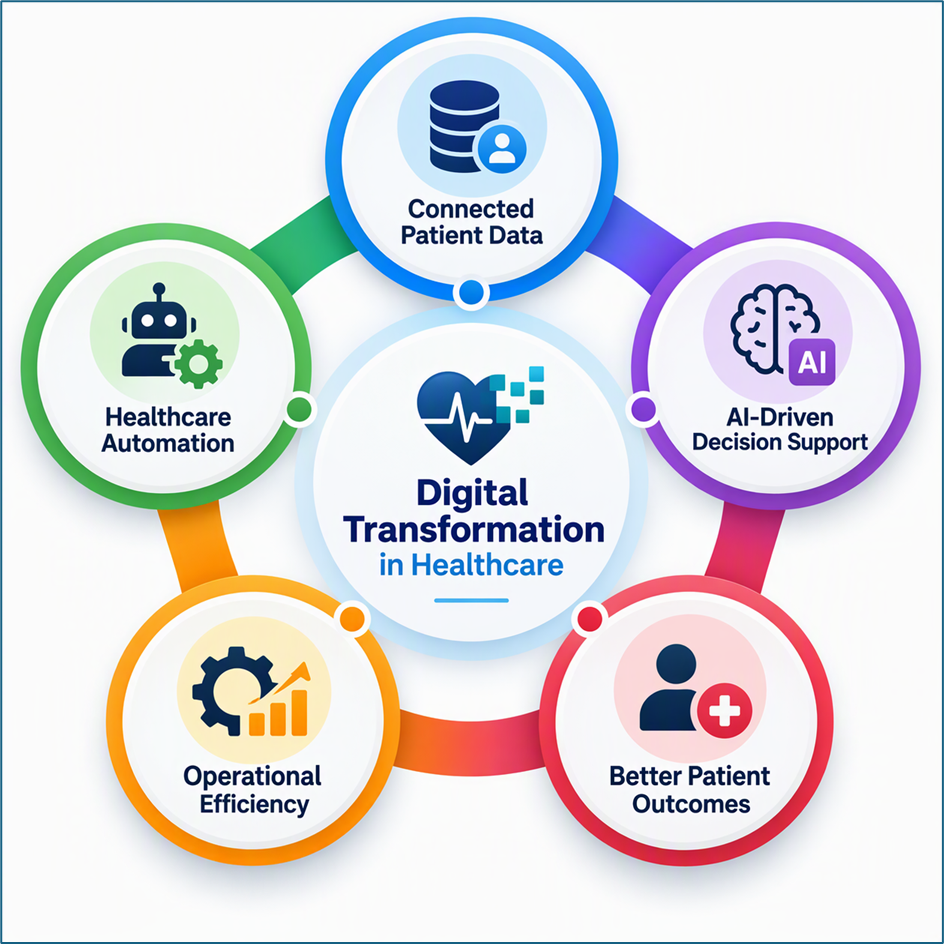
Interoperability is a key part of digital transformation in healthcare. It gives AI and automation access to more consistent information, helps departments work from shared records, and can bring relevant device data into connected workflows. Together, these links create connected healthcare systems and support wider healthcare transformation initiatives.
Extending Visibility Through IoT and Connected Medical Devices
IoT-connected medical devices and sensors give hospital teams better visibility into patient readings, equipment availability, and operational requirements.
- Remote Patient Monitoring: Connected patient monitors can transmit readings to clinical monitoring systems, allowing care teams to review patient data without relying on manual updates. Alerts for abnormal readings should have defined routing and an assigned owner for follow-up.
- Medical Equipment and Asset Tracking: IoT-enabled tracking helps staff locate infusion pumps, wheelchairs, and patient monitors across hospital wards. Managers can also compare equipment utilization across units and reassign idle assets to areas facing shortages before purchasing additional equipment.
- Capacity and Workflow Planning: Hospitals can use IoT applications in healthcare to connect device and asset data with existing systems. For longer-term planning, digital twins in healthcare can simulate hospital capacity, workflows, and equipment utilization under different scenarios before operational changes are implemented.
As hospitals connect more devices, they also need to protect the additional data being transmitted and stored. Device access controls, network security, and data protection measures should be part of the IoT implementation strategy.
Also read: Digital Transformation in Healthcare: AI, Telehealth, and Beyond
Balancing Innovation with Data Privacy and Security
Connected operations move patient information between staff, applications, and devices. Role-based access, authentication, permission reviews, and audit logs help control access and track changes. These safeguards should form part of an ongoing security risk management process.
IT and biomedical teams should inventory connected devices, track software updates, and identify equipment nearing the end of vendor support. Device updates should be coordinated with manufacturers and facility maintenance procedures to avoid disrupting clinical use. They also need retention rules and incident plans.
Regular risk assessments help teams find weaknesses before they disrupt operations or expose sensitive information. Procedures for device updates, maintenance, and incident reporting matter just as much. The HIPAA Security Rule requires regulated organizations to assess risks to electronic protected health information and implement reasonable and appropriate safeguards.
Information governance should define what data can be shared, who owns it, how long it’s kept, and how corrections are made. Clear rules help staff find records without exposing patient information unnecessarily. This is part of responsible digital modernization in healthcare.
Conclusion
Hospitals don’t need another layer of technology if the systems they already have can’t work together. Digital transformation in healthcare starts with everyday gaps: records that don’t travel, tasks that depend on manual follow-up, and equipment that’s hard to locate. Map the handoffs that cost staff the most time, connect the information those teams need, and measure whether delays and repeat work fall. These improvements can give staff more time to focus on patients.
At Futurism Technologies, we help healthcare organizations connect systems, patient data, and operational workflows through healthcare IT, integration, automation, AI, IoT, and cybersecurity services. Our goal is to help hospitals reduce manual work, improve coordination, and give care teams easier access to the information they need.
Let’s Make Your Hospital Systems Work Better Together.
Frequently Asked Questions
What is digital transformation in healthcare?
It uses connected systems and digital workflows to improve information management, team coordination, and care delivery. The goal is better operations, not simply new technology.
How does digital transformation improve hospital operations?
It reduces duplicate entry, automates routine tasks, improves access to patient information, and helps managers track staffing, capacity, and equipment.
Why is interoperability important in healthcare?
It lets systems exchange usable information, helping clinicians access records, avoid repeated work, and coordinate care between departments.
Where should a hospital start its digital transformation?
Choose a delayed workflow, such as registration, referrals, discharge, or equipment allocation. Map its handoffs and set a measurable goal before choosing a tool.
How can hospitals measure the success of digital transformation?
Track registration and claims processing times, duplicate data entry, referral turnaround times, equipment search time, device downtime, and manual follow-up hours. Compare results before and after changes.
How can hospitals keep connected systems secure?
Use role-based access, regular permission reviews, device updates, audit logs, and clear procedures for reporting and responding to incidents.

Edge Computing Explained: Understanding Its Impact on Digital Transformation

How To Unlock Multi-Trillion Dollar Opportunities with Data-Driven Digital Transformation

Cost Reduction in High-Tech: How Digital Transformation Can Save Millions

Digital Transformation in Healthcare: AI, Telehealth, and Beyond

Digital Transformation in High Tech: The Key to Superior Customer…
Redefining Tomorrow: A 2024 Playbook for Digital Transformation
Subscribe Now!
TRENDING POSTS
-
AI Personalization ROI: The $500M Opportunity for Enterprises
-
Zero-Click Marketing: Why Enterprises Must Rethink Attribution in the Digital Age
-
Agentic AI and Generative AI: What’s Best for Your Business?
-
Deepfake Scams: How to Protect Your Business in the Age of AI
-
AI and Cybersecurity: A Strategic Guide for C-Suite Leaders in 2025
-
How Location Intelligence is Revolutionizing BFSI: 6 Must-Know Benefits
-
Cloud and Data Engineering: The Path to Faster Insights and Smarter Decisions
-
From Delays to Innovation: How AI is Optimizing the Construction Industry
-
Data-Driven Future: 6 Trends to Watch Out For
-
The Impact of IoT on Reducing Maritime Carbon Footprints
-
Demystifying SASE: What is Secure Access Service Edge?
-
The Role of AI in Construction Safety
-
What Is Predictive Maintenance and Why Does It Matter?
-
What is Ransomware-as-a-Service (RaaS)? Everything You Need To Know
-
The Role of Smart Maritime IoT Solutions in Enhancing Maritime Safety
-
Revolutionizing Telecom with AI-Driven Network Slicing
-
Data Integration Unlocked: From Silos to Strategy for Competitive Success
-
Navigating the Shadows: Understanding Zero-Click Attacks in the Digital Age
-
AI Reimagined: Crafting Next-Gen AI Apps with Expert Fine-Tuning
-
Futurism AI: Turning Ideas into Apps at Lightning-Fast Speed
-
Accelerate AI Across Your Enterprise With Futurism AI
-
Flying into the Future: How AI is Redefining the Future of Aviation
-
Beyond Intelligence: The Rise of Self-Healing AI
-
The Indispensable Role of a Trusted Offshore AI Company in 2024 & Beyond
-
IoT-Powered Smart Warehouse Management: A Detailed Guide
-
Turning Data into Dollars: The Futurism Path to AI-Driven Success
-
5 Ways to Prepare Your Business for Digital Transformation
-
4 Ways To Win at Digital Transformation on a Shoestring Budget
-
Why AI in Digital Marketing is the Next Big Thing?
-
How AI Will Enable Faster Adaptation of Digital Transformation
-
How Is Digital Modernization Important In Supplier On-Boarding?
-
Top 10 Email Marketing Tips for This Holiday Season
-
Benefits of using ERP Software for Energy and Gas Industries
-
5 Features of Supply Chain Management Software
