Introduction
Introduction
Did you know? The global AIOps market size is projected to grow from $2.67 billion in 2026 to $11.8 billion by 2034. The demand for smarter, automated IT operations is clear and enterprises need to act now to stay competitive.
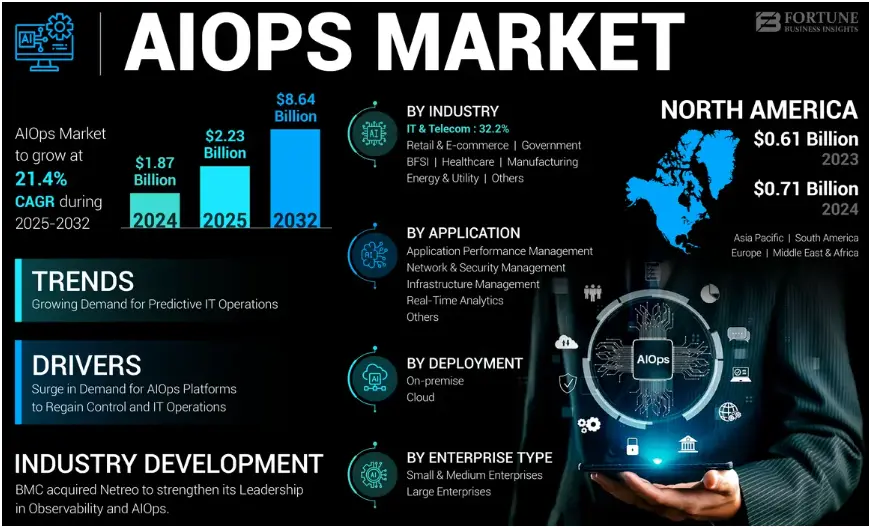
Source - fortunebusinessinsights.com
In this digital world staying ahead requires innovation, speed and precision. Artificial Intelligence for IT Operations (AIOps) is emerging as the game-changing technology enabling enterprises to transition from reactive IT management to proactive, automated systems that improve efficiency, reduce costs and enhance service delivery. As digital transformation accelerates, particularly in industries like BFSI, healthcare, manufacturing, retail, telecom, energy and utilities and more, AIOps is becoming the backbone of modern IT infrastructures.
For C-suite executives, IT decision makers, and operational leaders, adopting AIOps is no longer a luxury it’s a necessity. As companies scale and diversify their operations, the complexity of managing IT infrastructure grows exponentially. This is where AIOps steps in, integrating AI for IT operations and IoT to streamline processes, improve performance and deliver valuable insights in real-time.
In this guide, we’ll explore what is AIOps, how it works, why it’s critical for enterprises across various industries and provide a roadmap for successful implementation.
What is AIOps?
What is AIOps?
AIOps stands for Artificial Intelligence for IT Operations. At its core, AIOps is the application of
machine learning (ML), big data analytics and automation to manage and optimize IT operations. AIOps platforms analyze large volumes of data from various IT systems, including logs, metrics, tickets and network data, to detect anomalies, predict incidents and automate remediation.
The primary goal of AIOps is to enhance the ability to manage complex, multi-cloud, hybrid environments by:
- Automating routine operational tasks
- Identifying patterns or anomalies faster than manual systems
- Providing actionable insights for operational decision making
- Reducing the mean time to detect (MTTD) and mean time to repair (MTTR)
For enterprises facing the challenges of scaling IT environments, managing multi-cloud infrastructures and ensuring security and compliance, AIOps delivers the agility, scalability and automation needed to optimize operations.
The Key Components of AIOps
- Data Aggregation and Ingestion: AIOps platforms gather data from diverse sources such as logs, metrics, event data and network traffic. This data is then normalized and made actionable for deeper insights.
- Anomaly Detection and Pattern Recognition: Machine learning models identify deviations from normal behavior. These deviations could signal underlying issues such as performance degradation, security vulnerabilities or operational inefficiencies.
- Root Cause Analysis (RCA): AIOps platforms analyze correlated events to identify the root cause of incidents, enabling faster resolution and reducing reliance on manual troubleshooting.
- Automation and Orchestration: Once anomalies are detected and the root cause is identified, AIOps can trigger automated responses to mitigate incidents, such as scaling resources, restarting services or alerting relevant teams.
- Real-Time Monitoring and Reporting: AIOps platforms offer continuous monitoring, providing a single pane of glass view that integrates across IT infrastructure, enabling cross-functional teams (ITOps, DevOps, SecOps) to access shared data and insights.
Why AIOps Matters for U.S. Enterprises
Why AIOps Matters for U.S. Enterprises
For U.S. enterprises especially those in BFSI, healthcare, manufacturing and retail the need for advanced IT operations management is more pressing than ever. The increasing complexity of modern IT systems and the growing amount of data being generated has rendered traditional methods of monitoring and troubleshooting obsolete. AIOps offers significant advantages, enabling companies to address operational challenges efficiently.
1. Increased Operational Efficiency
AIOps automates much of the manual work involved in monitoring, data aggregation and incident response. By reducing the need for human intervention, businesses can improve operational efficiency and focus their IT teams on higher value activities. As a result, enterprises can streamline their IT management processes, which improves overall productivity and cost-effectiveness.
2. Improved IT Reliability and Performance
With AI for IT operations, businesses can detect and address performance issues before they escalate into critical outages or downtime. AIOps tools identify issues in real-time, allowing companies to respond more quickly and with greater precision. This proactive approach significantly improves service availability and reliability.
3. Cost Optimization and Resource Allocation
By utilizing artificial intelligence for IT operations, organizations can better manage their infrastructure, optimize resource allocation and avoid over provisioning. Real-time performance monitoring and predictive analytics allow businesses to allocate resources more efficiently, thus reducing operational costs.
4. Enhanced Security and Compliance
For industries like BFSI, healthcare and government, where regulatory compliance and data security are paramount, AIOps offers enhanced security features. Continuous monitoring and anomaly detection can help identify potential security threats, unauthorized access or breaches, enabling a quicker response to mitigate risks and comply with industry standards.
5. Scalability and Future-Proofing
As businesses grow, their IT infrastructure needs to scale accordingly. AIOps platforms are built to handle large volumes of data and complex IT environments. They provide the flexibility to scale with the business, whether it's managing an expanding cloud infrastructure, supporting the integration of new IoT devices or monitoring digital services as the company grows.
Key Benefits of AIOps for IT Operations:
Key Benefits of AIOps for IT Operations:
The implementation of AIOps offers several key benefits, particularly for enterprises that are embarking on a
digital transformation journey or looking to modernize their IT operations:
1. Proactive Incident Management and Issue Resolution
By leveraging machine learning and real-time analytics, AIOps platforms can predict and identify potential issues before they become critical. This proactive approach leads to faster problem resolution and reduced downtime, ensuring business continuity.
2. Automation of Repetitive Tasks
AIOps helps automate routine IT operations tasks such as log management, event correlation, incident ticketing and patch management. Automation reduces human error, increases the speed of response and frees up IT teams to focus on more strategic initiatives.
3. Comprehensive IT Infrastructure Visibility
AIOps offers an integrated, real-time view of the entire IT ecosystem. This unified visibility helps IT operations teams manage hybrid and multi-cloud environments efficiently, ensuring that all systems whether on-premise, in the cloud, or at the edge are continuously monitored and optimized.
4. Improved Collaboration across Teams
By centralizing data and insights, AIOps fosters collaboration between different teams within the organization such as ITOps,
DevOps, SecOps and business units. This integrated approach ensures faster decision making, efficient resource allocation and better overall IT management.
Implementing AIOps: A Step-by-Step Roadmap for Success
Implementing AIOps: A Step-by-Step Roadmap for Success
Adopting AIOps in your enterprise requires careful planning, strategy and execution. Below is a structured roadmap to help you successfully implement AIOps and maximize its value for your organization:
Step 1: Define Clear Business Objectives
Before diving into AIOps implementation, it’s essential to define the specific business problems you're trying to solve. This could range from improving application uptime in the retail sector, optimizing cloud infrastructure in BFSI or enhancing production line efficiency in manufacturing. Clear objectives will help you tailor the AIOps strategy to meet business goals.
Step 2: Assess Your Current IT Landscape
Evaluate your existing IT infrastructure, tools and processes to identify gaps or inefficiencies. This includes reviewing your current monitoring and management systems, as well as understanding where AIOps can add the most value. Ensure that the necessary data sources, such as logs, metrics, and event data, are being captured and are ready to be integrated with AIOps tools.
Step 3: Select the Right AIOps Platform
Choose an AIOps solution that fits your enterprise’s specific needs. Key considerations include:
- Compatibility with existing IT systems and infrastructure
- Scalability to handle large data volumes and complex environments
- Integration capabilities with cloud platforms, IoT devices, and other technologies
- AI/ML capabilities for advanced anomaly detection and predictive analytics
Step 4: Begin with a Pilot Program
Start with a pilot program focused on a specific use case, such as anomaly detection in network traffic or cloud cost optimization. Piloting the AIOps platform allows you to fine-tune configurations and measure the system’s effectiveness in solving business challenges before full-scale implementation.
Step 5: Scale AIOps across the Organization
Once the pilot proves successful, expand AIOps integration to other areas of IT operations. This may include adding new use cases, integrating additional data sources, or involving more teams across the enterprise (such as DevOps or SecOps).
Step 6: Continuously Monitor and Improve
AIOps is not a one-time implementation. It requires continuous monitoring and optimization. Regularly assess the platform’s performance, refine algorithms, and incorporate feedback from IT teams to ensure the solution is providing maximum value.
AIOps Use Cases
AIOps Use Cases
BFSI (Banking, Financial Services and Insurance)
AIOps can optimize financial institutions' IT operations by:
- Reducing fraud detection times
- Automating compliance reporting
- Enhancing risk management and operational resilience
Healthcare
In healthcare, AIOps helps monitor and manage critical medical devices and applications, ensuring continuous service availability and regulatory compliance. It can also aid in the automation of patient data management and secure access control.
Manufacturing
AIOps supports smart factories by improving predictive maintenance, optimizing production schedules, and reducing downtime due to equipment failure.
Retail and eCommerce
For retail and eCommerce companies, AIOps ensures smooth customer experiences by monitoring website performance, improving checkout processes and predicting infrastructure scaling needs during peak traffic events.
Telecom and Utilities
AIOps in telecom can improve network uptime, automate network optimization, and provide insights for better capacity planning. For utilities, AIOps can optimize energy distribution, manage assets efficiently, and enhance grid resilience.
Conclusion:
Conclusion:
As enterprises embrace digital transformation and adapt to evolving IT landscapes, AIOps will play an increasingly central role in managing the complexities of modern infrastructures. By incorporating artificial intelligence for IT operations into their strategies, businesses can achieve greater agility, reduce operational costs, improve service reliability, and future-proof their IT environments.
At
Futurism Technologies, we specialize in helping organizations across industries integrate AI for IT operations and IoT solutions into their digital transformation journeys. Our expertise in implementing AIOps solutions allows us to deliver robust, scalable, and secure infrastructures tailored to meet the specific needs of your business.
Ready to accelerate your IT operations and unlock the full potential of AIOps? Contact Futurism Technologies today to discuss how we can help your organization leverage AIOps for operational excellence.
FAQs
FAQs
1. What is AIOps and why is it important for enterprises?
AIOps, or Artificial Intelligence for IT Operations, is the application of machine learning (ML),
big data analytics and automation to enhance and optimize IT operations. It helps businesses monitor complex IT environments, detect anomalies, automate routine tasks and resolve issues faster. As IT infrastructures grow more complex, AIOps enables enterprises to transition from reactive management to proactive and predictive IT operations, improving overall efficiency, reducing downtime and cutting operational costs.
2. How does AIOps improve IT operations?
AIOps improves IT operations by automating routine tasks, analyzing large volumes of data in real-time and detecting anomalies faster than manual systems. It enhances the ability to predict incidents, perform root cause analysis and automate remediation actions. This proactive approach reduces mean time to detect (MTTD) and mean time to repair (MTTR), which ultimately leads to better service reliability, increased operational efficiency and cost optimization.
3. What are the key benefits of implementing AIOps?
Implementing AIOps offers several key benefits for enterprises, including:
- Increased operational efficiency through automation of routine tasks.
- Improved IT reliability by detecting and resolving issues before they escalate.
- Cost optimization by reducing the need for manual intervention and optimizing resource allocation.
- Enhanced security and compliance, especially in industries with stringent regulations like BFSI and healthcare.
- Scalability to support growing IT environments and adapt to future demands.
4. How do AIOps platforms use machine learning for IT operations?
AIOps platforms leverage machine learning (ML) to analyze vast amounts of IT data, including logs, metrics and event data, to identify patterns and anomalies. By using algorithms that continuously learn from historical and real-time data, AIOps can predict incidents, detect potential risks and automate responses. This reduces manual troubleshooting and helps IT teams quickly address issues, ensuring better performance and service availability.
5. What industries benefit most from AIOps?
AIOps is beneficial across various industries, but it’s especially impactful in the following sectors:
- BFSI: AIOps improves fraud detection, risk management and compliance reporting.
- Healthcare: It ensures the availability of critical systems and helps manage medical devices and patient data securely.
- Manufacturing: AIOps aids in predictive maintenance, reducing downtime and optimizing production.
- Retail and eCommerce: It ensures smooth customer experiences, from website performance monitoring to inventory management.
- Telecom and Utilities: AIOps helps optimize network performance and improve service reliability.
6. How do I start implementing AIOps in my organization?
To begin implementing AIOps in your organization, follow these steps:
- Define clear business objectives: Identify what you aim to achieve with AIOps (e.g., reducing downtime, improving service availability).
- Assess your current IT infrastructure: Evaluate your existing monitoring systems, tools, and processes.
- Choose the right AIOps platform: Select a platform or organization that fits your needs in terms of scalability, integration and machine learning capabilities.
- Pilot the solution: Start with a small-scale implementation to test the system’s effectiveness before expanding it across the organization.
- Scale and optimize: Gradually integrate more data sources and expand AIOps usage across different IT operations as you refine the platform’s performance.
At Futurism Technologies, we specialize in helping organizations seamlessly integrate AIOps solutions into their IT operations. Our expert team can assist you with everything from strategy to full-scale implementation and optimization.
7. What is the difference between AIOps and traditional IT operations management?
The key difference between AIOps and traditional IT operations management lies in the use of automation and machine learning. Traditional IT management typically involves manual processes for monitoring, troubleshooting and resolving issues, which can be slow and error prone. In contrast, AIOps platforms leverage AI and big data analytics to automate incident detection, root cause analysis and remediation. This enables businesses to transition from reactive, manual processes to a proactive, data driven approach that improves efficiency, speed and accuracy in IT operations.