How to Choose the Right Cloud for Your Enterprise: AWS, Azure, or Google Cloud – A Strategic CTO Guide

Futurism Technologies
June 11, 2026 - 6.2K 5 Min Read
In the modern enterprise, cloud decisions aren’t just technical, they define how your organization innovates, scales, and competes. Pick the wrong platform, and you pay with ballooning costs, operational friction, or slow time-to-market. Pick the right one, and your cloud becomes a strategic accelerator.
With cloud spending projected to surpass $419 billion in 2025 and exceed $800 billion by the end of 2026, CTOs need more than feature comparisons they need a decision framework rooted in real-world trade-offs, costs, and talent realities.
This blog gives you exactly that: a practical, step-by-step CTO framework to pick the right cloud, aligned with business goals, technical realities, and operational capacity. Whether you’re exploring cloud data engineering options or planning a major migration, the right strategy can dramatically accelerate your digital transformation.
The Cloud Market Landscape
Before comparing features, it helps to understand where the cloud landscape stands in 2026:
- AWS (Amazon Web Services) leads with roughly 31% global market share. It remains the clear market leader, backed by the broadest service catalog in the industry (over 200 managed services) and strong adoption across startups and enterprises alike.
- Microsoft Azure holds 23-25% share and continues to solidify its second-place position. It is the fastest growing of the Big Three in absolute revenue terms, driven by deep Microsoft 365 and enterprise integration, hybrid cloud strengths, and its exclusive OpenAI partnership.
- Google Cloud controls 11-12% of the market. While it has the smallest share among the hyperscales, it is showing the strongest percentage growth, particularly excelling in data analytics, machine learning, and Kubernetes-native workloads.
Together, these three hyperscales control roughly 68% of the global cloud infrastructure market. These providers dominate because they balance massive scale, reliability, compliance, and rapid innovation, making them the default choice for enterprises and mid-market organizations alike.
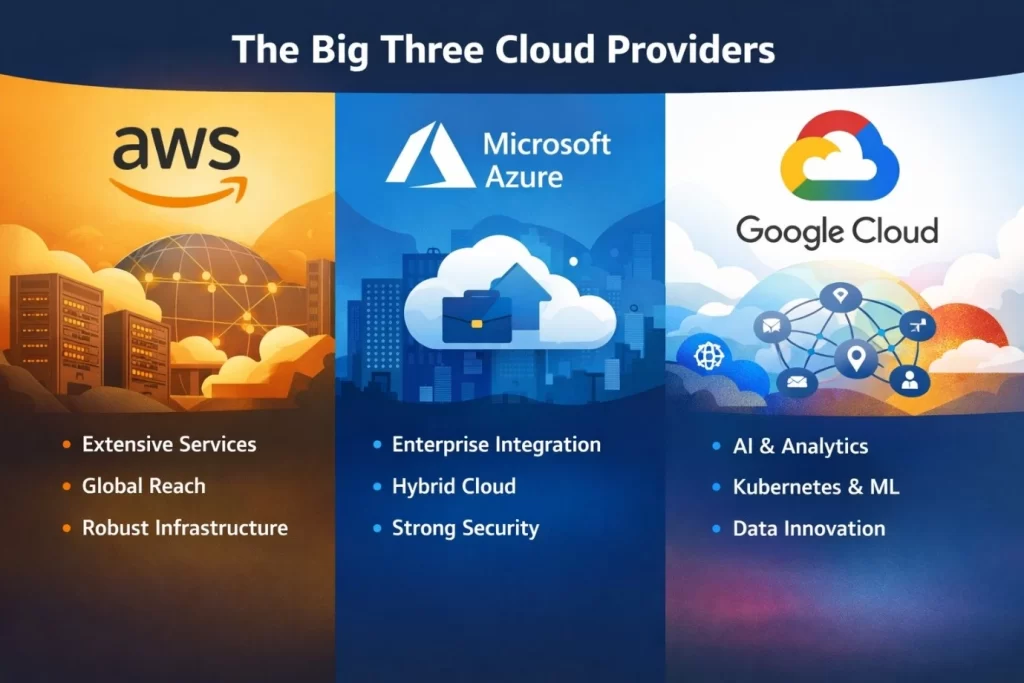
The Big Three Cloud Providers
Before diving into the decision framework, let’s briefly understand the strategic positioning of each platform.
Amazon Web Services (AWS)
Amazon Web Services was the first major hyperscale cloud provider, launching in 2006. Its early start allowed it to build the largest global cloud ecosystem.
Strengths:
- Broadest service portfolio
- global infrastructure footprint
- mature developer ecosystem
- strong compute and infrastructure capabilities
AWS is often the default choice for cloud-native startups and SaaS platforms because of its flexibility and depth of services.
Microsoft Azure
Microsoft Azure has become the preferred cloud platform for many enterprises, particularly those deeply integrated with the Microsoft ecosystem.
Strengths
- seamless integration with Microsoft enterprise tools
- strong hybrid cloud capabilities
- enterprise security and compliance frameworks
- deep relationships with large enterprises
Organizations already using Microsoft 365, Windows Server, or enterprise Microsoft software often find Azure easier to adopt.
Google Cloud Platform
Google Cloud Platform has positioned itself as the innovation-focused cloud, particularly around data, AI and analytics.
Strengths
- advanced data analytics capabilities
- industry-leading AI and machine learning tools
- strong Kubernetes and container ecosystem
- expertise in large-scale distributed systems
Enterprises focusing on data engineering in the cloud often find Google Cloud particularly compelling.
A CTO’s Decision Framework for Choosing the Right Cloud
Rather than asking “Which cloud is best?”, technology leaders should ask:
“Which cloud platform best supports our business priorities?”
Below are the key decision factors CTOs should evaluate.
1. Business Strategy Alignment
The first consideration is not technical, it’s strategic.
Different cloud platforms naturally align with different business models.
When AWS Makes Sense
AWS often works best for:
- cloud-native startups
- SaaS platforms
- global digital products
- Engineering-heavy organizations
Its extensive service ecosystem makes it ideal for teams that need maximum flexibility and customization.
When Azure Is the Right Fit
Azure tends to be the best choice for:
- large enterprises
- organizations using Microsoft technologies
- hybrid cloud environments
- regulated industries
For companies migrating from legacy enterprise infrastructure, Azure often offers the smoothest transition.
When Google Cloud Stands Out
Google Cloud is attractive for organizations that prioritize:
- AI-driven innovation
- data analytics
- Machine Learning Pipelines
- modern application architecture
Technology companies building data-intensive platforms often find Google Cloud particularly compelling.
2. Workload Requirements
Not all workloads are created equal.
A CTO must evaluate the type of applications and systems that will run in the cloud.
Typical enterprise workloads include:
- legacy system modernization
- microservices-based applications
- AI and machine learning workloads
- high-performance computing
- data processing pipelines
AWS excels in infrastructure flexibility, Azure in enterprise integration, and Google Cloud in cloud-driven data insights for enterprises. Many organizations today adopt multi-cloud strategies to optimize for different workloads.
3. Security, Compliance and Governance
For industries such as banking, healthcare and telecom, security and regulatory compliance are non-negotiable.
Cloud providers now offer robust frameworks to support enterprise governance, including:
- identity management
- encryption and threat monitoring
- regulatory compliance certifications
- data residency controls
Azure has historically had an advantage in enterprise compliance because of its integration with Microsoft security ecosystems.
However, AWS and Google Cloud have significantly expanded their security and compliance capabilities in recent years.
For CTOs, the key question becomes:
Does the cloud provider support the regulatory requirements of your industry and region?
Read Also: The Anatomy of a Cloud Security Attack
4. Developer Experience and Innovation
Modern engineering teams care deeply about developer productivity and innovation speed.
Key considerations include:
- API availability
- automation capabilities
- DevOps tooling
- container orchestration
- CI/CD pipelines
Google Cloud has been particularly influential in this space.
After all, Kubernetes, the dominant container orchestration platform, originated at Google.
AWS, meanwhile, offers one of the largest developer ecosystems, with extensive tooling for building scalable applications.
Azure focuses on developer productivity through tight integration with Visual Studio and enterprise development environments.
5. Global Infrastructure and Performance
For global businesses, infrastructure scale matters.
Cloud providers operate networks of data centers across multiple regions to ensure:
- low latency
- high availability
- geographic redundancy
AWS currently maintains the largest global cloud footprint, while Azure and Google Cloud continue expanding aggressively.
For companies deploying consumer facing applications or global SaaS platforms, infrastructure reach can significantly affect performance.
6. Cost Structure and Long-Term Economics
Cloud pricing is complex and often misunderstood.
Each provider uses a mix of pricing models such as:
- pay-as-you-go usage
- reserved instances
- committed use discounts
- enterprise agreements
While pricing differences exist, the reality is that architecture decisions often impact on costs more than the provider itself.
For example:
- inefficient data architecture can increase storage costs
- poorly optimized compute workloads can inflate infrastructure bills
This is why many organizations focus on cloud cost optimization strategies rather than switching providers.
7. Multi-Cloud and Hybrid Strategies
Today, many enterprises are moving beyond the “single cloud” mindset.
Hybrid and multi-cloud strategies are becoming increasingly common.
According to research from Gartner, 90% of organizations are expected to adopt hybrid cloud environments by 2027.
A multi-cloud strategy allows businesses to:
- avoid vendor lock-in
- improve resilience
- optimize workloads across platforms
- leverage specialized capabilities
For example:
- core infrastructure on AWS
- enterprise workloads on Azure
- AI and analytics on Google Cloud
This approach is increasingly common among large enterprises and technology companies. Learn how to secure hybrid and multi-cloud environments with the SASE framework guide.
Real-World Considerations for CTOs
Beyond features and capabilities, CTOs should also consider organizational readiness.
Questions worth asking include:
- Do we have the in-house expertise for this platform?
- How easily can our teams migrate existing workloads?
- What training and operational changes are required?
- How will this platform support our innovation roadmap?
Cloud strategy is not just about technology, it’s about people, processes and long-term transformation.
The Future of Cloud: AI, Data, and Intelligent Infrastructure
Cloud competition is increasingly centered around AI infrastructure and advanced data capabilities.
Each hyperscaler is investing heavily in AI platforms, developer tools and automation capabilities to support the next generation of digital applications.
This shift means cloud platforms are evolving from infrastructure providers to innovative ecosystems.
For enterprises, the most important question may soon be:
Which cloud platform best enables our future AI and data strategy?
Final Thoughts:
There is no universal winner in the AWS vs Azure vs Google Cloud debate. Each platform has its strengths:
- AWS: Scale and service breadth
- Azure: Enterprise integration and hybrid cloud
- Google Cloud: Data, analytics, and AI innovation
For CTOs, the choice depends on business goals, workloads, compliance needs, and long-term strategy. Increasingly, the question isn’t just “Which cloud should we choose?” but “How do we design a cloud strategy that drives innovation, resilience and growth?”
This is where experienced digital transformation partners make a difference. Organizations modernizing legacy systems, building scalable platforms or enabling AI-driven applications benefit from strategic guidance and deep engineering expertise.
At Futurism Technologies, cloud transformation is treated as a strategic journey, not a one-time project. With services spanning cloud consulting, migration, modernization, infrastructure management, cloud security and DevOps, Futurism partners with AWS, Azure and Google Cloud to help enterprises build resilient, future-ready cloud ecosystems that drive innovation and growth. Ultimately, the goal isn’t just choosing a platform it’s building a cloud foundation that powers innovation for the next decade.
Ready to Build a Smarter Cloud Strategy?
If your organization is evaluating cloud platforms, planning a migration or optimizing your cloud environment, partnering with experienced cloud specialists can simplify complexity and accelerate outcomes.
Explore Futurism Technologies’ cloud computing services to design scalable, secure and innovation ready cloud ecosystems.
FAQs:
1. Which cloud platform is best for enterprises: AWS, Azure or Google Cloud?
There is no one size fits all answer. The best cloud platform depends on an organization’s existing technology stack, business goals, and workload requirements. Amazon Web Services (AWS) offers the largest ecosystem and is widely used for cloud-native applications. Microsoft Azure is often preferred by enterprises that already rely on Microsoft tools and need strong hybrid cloud capabilities. Google Cloud Platform (GCP) is known for its strengths in data analytics, artificial intelligence, and modern application development.
2. How should CTOs evaluate cloud platforms for long-term scalability?
CTOs should evaluate cloud providers based on several strategic factors, including global infrastructure availability, developer ecosystem, security compliance, and support for emerging technologies like AI and machine learning. It is also important to assess how well the platform supports future innovation, multi-cloud strategies, and large-scale application deployment, rather than focusing only on current infrastructure needs.
3. Is a multi-cloud strategy better than choosing a single cloud provider?
Many organizations are adopting multi-cloud or hybrid cloud strategies to reduce vendor dependency, increase resilience, and optimize workloads across platforms. For example, a company might run core infrastructure on AWS, enterprise applications on Azure, and data analytics workloads on Google Cloud. However, a multi-cloud strategy requires strong governance, architecture planning, and cloud management capabilities to avoid operational complexity.
4. What are the biggest challenges organizations face when migrating to the cloud?
Common cloud migration challenges include legacy system compatibility, cost management, security and compliance requirements and a lack of internal cloud expertise. Organizations often underestimate the complexity of modernizing applications, redesigning architecture, and managing cloud infrastructure efficiently. Successful cloud adoption typically requires a clear strategy, skilled engineering teams, and ongoing optimization after migration.
5. How can Futurism Technologies help enterprises choose the right cloud platform?
Choosing the right cloud platform requires balancing business goals, compliance, security and long-term scalability. Futurism Technologies helps enterprises navigate this complexity by providing strategic cloud consulting, migration planning, and end-to-end cloud management. Whether organizations are modernizing legacy systems, adopting AI-driven workloads, or implementing hybrid and multi-cloud strategies, Futurism guides CTOs and technology leaders to build resilient, future-ready cloud ecosystems that align with both technical and business objectives.


How Cloud Is Solving the Most Annoying Problems for eCommerce…
Office 365 Migration Vendor: How to Select the Right One

Key Office 365 Migration Challenges And How We Overcome Them

Top Features of Office 365 That Competitively Set You Apart

5 Superlative Benefits of Office 365 Which Can Boost Your…
Subscribe Now!
TRENDING POSTS
-
AI Personalization ROI: The $500M Opportunity for Enterprises
-
Zero-Click Marketing: Why Enterprises Must Rethink Attribution in the Digital Age
-
Agentic AI and Generative AI: What’s Best for Your Business?
-
Deepfake Scams: How to Protect Your Business in the Age of AI
-
AI and Cybersecurity: A Strategic Guide for C-Suite Leaders in 2025
-
How Location Intelligence is Revolutionizing BFSI: 6 Must-Know Benefits
-
Cloud and Data Engineering: The Path to Faster Insights and Smarter Decisions
-
From Delays to Innovation: How AI is Optimizing the Construction Industry
-
Data-Driven Future: 6 Trends to Watch Out For
-
The Impact of IoT on Reducing Maritime Carbon Footprints
-
Demystifying SASE: What is Secure Access Service Edge?
-
The Role of AI in Construction Safety
-
What Is Predictive Maintenance and Why Does It Matter?
-
What is Ransomware-as-a-Service (RaaS)? Everything You Need To Know
-
The Role of Smart Maritime IoT Solutions in Enhancing Maritime Safety
-
Revolutionizing Telecom with AI-Driven Network Slicing
-
Data Integration Unlocked: From Silos to Strategy for Competitive Success
-
Navigating the Shadows: Understanding Zero-Click Attacks in the Digital Age
-
AI Reimagined: Crafting Next-Gen AI Apps with Expert Fine-Tuning
-
Futurism AI: Turning Ideas into Apps at Lightning-Fast Speed
-
Accelerate AI Across Your Enterprise With Futurism AI
-
Flying into the Future: How AI is Redefining the Future of Aviation
-
Beyond Intelligence: The Rise of Self-Healing AI
-
The Indispensable Role of a Trusted Offshore AI Company in 2024 & Beyond
-
IoT-Powered Smart Warehouse Management: A Detailed Guide
-
Turning Data into Dollars: The Futurism Path to AI-Driven Success
-
5 Ways to Prepare Your Business for Digital Transformation
-
4 Ways To Win at Digital Transformation on a Shoestring Budget
-
Why AI in Digital Marketing is the Next Big Thing?
-
How AI Will Enable Faster Adaptation of Digital Transformation
-
How Is Digital Modernization Important In Supplier On-Boarding?
-
Top 10 Email Marketing Tips for This Holiday Season
-
Benefits of using ERP Software for Energy and Gas Industries
-
5 Features of Supply Chain Management Software
